Skip to content
Sanctuary Mix

For sound and worship leaders

Train your sound team, one Sunday at a time

Learn one small step at a time on your phone. Try it at church with someone beside you. Your sound team leader watches you do it, then ticks it as done.

Lesson 2, Follow the signal, and lesson 6, Speech that stays steady. No sign-up.

Your first Sunday is a service with no band, only speaking. Your mentor (an experienced team member who helps you) is close by.

The training

Online training for your whole team

It comes with the team licence: short lessons on a phone, and a task to try at church after each one. At each step of the ladder there's a sign-off (your sound team leader watches you do it, then ticks it).

  1. Learn

    Short lessons with the book's drawings, and practice tools. They play real recordings and computer-made sound, and say which. In them you set the gain (how much the desk strengthens the sound coming in), find a booming note and mix a practice band. The lessons are written, with no video yet.

  2. At church

    Each lesson ends with one task at a rehearsal or midweek meeting, beside a mentor.

  3. Take the quiz

    Twenty or more questions per level about what you'd do on a Sunday, with the reason for every answer.

  4. The sign-off at your church

    At church, your leader watches you do each item, then ticks it. Someone at your church with Level 3, or an experienced sound person your leader chooses, can tick it too. When every item is ticked, that level's certificate is ready.

31
lessons in three levels
120
Check yourself questions, each with its reason
38
things your sound team leader watches you do at church

For leaders

  • Invite your team with one message, and see where everyone is on the ladder.
  • See who needs you this week: who is ready to be watched, stuck on a quiz, or has done nothing for 3 weeks.
  • Tick each item you've seen them do at church, on your phone or on the printed sheet.
  • Print a one-page team report, or add your pastor as view-only (they can look, but not change anything).

Try two lessons free How the training works

See it

What the training does

The Sunday ladder

From scared of the desk to mixing on Sunday

Most church sound is run by volunteers. Someone showed them the power switch, said "good luck" and left. They care, and they arrive early. They still get the blame when the singer can't be heard, or the chorus is too loud.

Three levels of small steps, with a Sunday at the end of each. At your church, your leader ticks each step once you can do it without help, not just once.

  1. Level 1: Essentials

    Your Sunday: the Level 1 certificate, trusted to run a service with no band, only speaking, at your church.

    The four steps, and the 14 things your leader watches you do
    1. Step 1, Watch

      • Sat beside someone for a full service
      • Can name the parts of the system, from mic to speaker
      • Knows the team's hand signals and talkback words

      3 sign-off items · Before this Sunday, free

    2. Step 2, Help

      • Places and connects the stage gear at the tape marks
      • Runs, labels and coils cables properly
      • Does a line check from the checklist
      • Changes batteries and swaps a failed mic calmly

      The line check tests everything, one by one, before the service.

      4 sign-off items · Sunday cards, free

    3. Step 3, Learn the channel (for speech)

      • Sets each channel's gain to the target on the meter
      • Uses the high-pass and makes useful EQ cuts
      • Uses gentle compression on speech, so the voice never sounds dull and lifeless

      3 sign-off items

    4. Level 1 service

      Your first Sunday is a service with no band, only speaking. Your mentor is close by.

      • Runs a service with no band, only speaking, with a mentor close by
      • Knows what to do when a mic starts to feed back, and keeps spare mics muted
      • Measures how loud the service is, and writes it in the volume log
      • Puts the gear away in the right order, saves the desk's settings file and writes a handover note

      4 sign-off items

      Your Sunday: the Level 1 certificate, trusted to run a service with no band, only speaking, at your church.

  2. Level 2: The Full Band

    Your Sunday: the Level 2 certificate, trusted to mix a full band, with earphone mixes, and with tracks if the church uses them, at your church.

    The three steps, and the 13 things your leader watches you do
    1. Step 3, Learn the channel (for the band)

      • Puts mics on a drum kit (or connects an electronic kit), and checks no two mics cancel each other
      • Uses the high-pass on every band channel, and EQ, not volume, so the singer is heard clearly
      • Uses gentle compression on the band, and gates the toms only where it helps (or raises them by hand)
      • Makes a reverb and a delay in time with the song, on post-fader sends and their own DCA

      A DCA is a remote control for several channels. No sound goes through it.

      4 sign-off items

    2. Step 4, Mix with a mentor

      • Makes each musician's earphone mix (in-ears), together with that musician
      • Mixes a rehearsal, then part of a service
      • Keeps speech clear, and the changes between songs and speaking smooth
      • Keeps the volume within the agreed limits

      4 sign-off items

    3. Level 2 service

      • Runs the soundcheck in order (instruments, singers, then the musicians' earphones before the main speakers) and keeps it short
      • Keeps talkback, and any click and cues, in the musicians' earphones only
      • Runs a full band service with a mentor close by (with tracks, if your church uses them)

      The soundcheck is a test of each voice and instrument before the service. The click is a steady beat only the musicians hear.

      5 sign-off items, 3 shown

      Your Sunday: the Level 2 certificate, trusted to mix a full band, with earphone mixes, and with tracks if the church uses them, at your church.

  3. Level 3: Lead the Team

    Your Sunday: the Level 3 certificate, trusted to lead the sound team, run the stream mix and stay calm when things go wrong at your church.

    The three steps, and the 11 things your leader watches you do
    1. Step 5, Run a Sunday: the stream

      • Makes and checks the stream mix, with no cues or talkback on it
      • Sets the stream's volume and loudness, checks lip sync, and listens to the recording after the service

      2 sign-off items

    2. Under pressure

      • At a practice, moves a speaker or singer to the spare mic in under ten seconds. Practises the switch to backup power, and times it
      • Stays calm when things go wrong, writes down every problem, and talks about it with the team afterwards
      • Agrees a written volume target with the pastor and worship leader, and keeps the volume log against it

      5 sign-off items, 3 shown

    3. Step 6, Train someone

      • Has taken someone else through the first two steps
      • Can explain the desk guide and backup plan
      • Plans the roster a month ahead, with a backup for every job
      • Leads the short team meeting before the service, and the short talk after it

      4 sign-off items

      Your Sunday: the Level 3 certificate, trusted to lead the sound team, run the stream mix and stay calm when things go wrong at your church.

The guide, the training's textbook

A big church's standards, without a big church's budget

The guide is a PDF of fourteen chapters, each ending with a "This Sunday" checklist. It comes with 36 printables (one-page sheets for the desk) and a planning spreadsheet.

Every sound word is explained, and there's a word list (glossary) of 187 terms at the back.
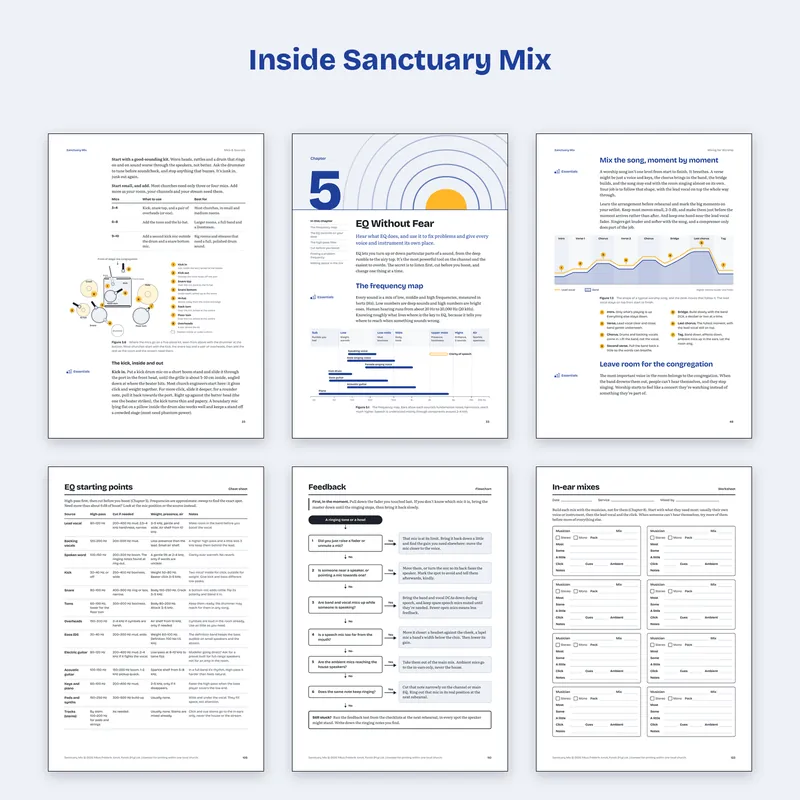
Six pages from inside Sanctuary Mix: the drum kit plan, the EQ chapter opener, a song energy map, the EQ cheat sheet, the feedback flowchart and the worksheet for the musicians' earphone mixes
See these six pages larger

Every lesson names its pages

In the book: Chapter 2: The signal chain; Cables and connectors; Four signal levels; Label everything, front to back; When the signal goes missing; Clean power, quiet system.

From lesson 2, Follow the signal

  • Essentials. What everyone needs. New? Read these first.
  • Next step. More to understand, once the essentials feel familiar.
  • Pro tip. Small habits that make a good mix better, once the basics feel easy.
  • Stewardship. A short reflection on why this work matters.
What each chapter covers
  1. 1. Why Sound Is Worship. Who comes first in the mix, and standards you can adopt this week.
  2. 2. Follow the Signal. Cables, how strong the sound is along the way, labels and clean power.
  3. 3. Mics & Sources. Choosing and holding mics, and DI boxes. Two mics that cancel each other (phase). The mics on a drum kit, step by step. Phantom power and wireless mics.
  4. 4. Gain Staging. Set how strong each sound is at the start, step by step.
  5. 5. EQ Without Fear. The deep, middle and high sounds, the high-pass filter, and turning down before you turn up.
  6. 6. Dynamics & Effects. Compressors, gates, reverb and the delay effect, step by step.
  7. 7. Mixing for Worship. The order to add each sound, DCAs, stereo, mixing the drums, and letting the people's own singing be heard.
  8. 8. In-Ear Monitors First. Earphones for the musicians (in-ears) for any budget, mixes musicians love, and moving your team from floor speakers (wedges) to earphones.
  9. 9. Test Before Sunday. Stop feedback before it starts. Test everything, one by one, before the service (the line check), then each voice and instrument (the soundcheck). A backup for everything.
  10. 10. The Room & Volume. Where the speakers go and their settings, measuring how loud it is, and how loud is right for modern worship.
  11. 11. Livestream Audio. A separate mix for the livestream (the service shown online), how loud it is, and keeping sound and picture together (lip sync).
  12. 12. Your Sunday Workflow. From getting ready during the week to putting the gear away, including stages where the gear stays out.
  13. 13. A Team That Serves. A path for new volunteers, and passing the desk to the next person. Working with the worship leader (who leads the songs and the band) and the pastor, and planning the budget.
  14. 14. The Tech Around the Desk. Earphone systems, the musicians mixing their own earphones from their phones, and amp modellers (boxes that copy a guitar amp's sound). Also tracks (recorded music played with the band), and sound from the presentation computer. Streaming with OBS (free software that sends the stream) and a production computer.

Have you mixed for a while? The Next step and Pro tip sections teach more:

  • DCAs for every change.
  • Stereo for modern worship.
  • Phase.
  • Subwoofers that send less sound backwards (cardioid subs).
  • How loud the stream should be.

Pastors and worship leaders will find what their team needs. They'll find how to talk about volume and budget, and how to build a sound team that keeps going for years.

See all 36 printables

2 sheets for your first Sundays: Before this Sunday and Sunday first aid, at the front of the guide.

6 cheat sheets:

  • A frequency reference: the deep, middle and high sounds.
  • Starting settings for EQ, compression and gates on every common sound. They include the kick drum's two mics, the bass DI, amp modellers, pads (long, soft keyboard sounds) and tracks.
  • Mics and mixing for the drums.
  • A quick guide for analogue desks.

6 flowcharts (charts of what to check, step by step):

  • No sound.
  • Feedback.
  • A muddy or harsh mix.
  • A musician who can't hear in their earphones.
  • Earphone or wireless sound that stops or crackles.
  • A livestream that sounds wrong.

5 checklists: setup (placing and connecting the gear), line check, soundcheck, the monthly feedback and backup test, and service and teardown (putting the gear away).

17 worksheets:

  • A sign-off sheet for every step of the Sunday ladder.
  • Channel list, output patch and stage plot.
  • In-ear mixes, a guide for the band about their earphones, and cue sheet.
  • Backup plan, problem log and volume log.
  • Build sheets for an absorbent panel and a drum screen.
  • A Sunday review scorecard and your own desk guide.
  • Handover note, team rota and budget plan.

The guide also comes with a planning spreadsheet you can edit. Its seven tabs are the budget plan, rota, handover log, input patch, output patch, problem log and volume log.

Free for your team

Sheets, tools and guides for your church sound team. None of them needs an account.

  • Before this Sunday

    For a new volunteer: seven steps to read before your first Sunday at the desk.

  • Sunday cards

    Four cards for the desk: Before this Sunday, the line check, Sunday first aid and When feedback happens. Print them, or read them on your phone before the service.

    PDF, 52 KB

  • Plan your stage

    For whoever plans the stage: put your band, singers and speakers on it, and the channel list writes itself. Print it, or send it to your team as a PDF.

See all 14 free resources

Who will use it?

Choose your copy

  1. For a new volunteer

    Essentials

    about US$15R249 in randR249

    37-page PDF

    Chapters 4 to 6: setting the gain, the tone controls (EQ), and compressors, gates and effects. Printables: 11, in the guide and in a PDF of their own. What's in Sanctuary Mix Essentials

    Orders open soon. Tell me when.

  2. For you

    Personal copy

    about US$29R499 in randR499

    200-page PDF

    All 14 chapters, all 36 printables (in the guide and in a PDF of their own) and the planning spreadsheet.

    Orders open soon. Tell me when.

  3. Best for churches

    For your church team

    Team licence

    about US$83R1 399 in randR1 399

    The guide for everyone, plus the training. Paid once. Your whole team, one church.

    Online training for your team
    Three levels, each about ten weeks at a lesson a week, with a sign-off at your church.
    The guide
    All 14 chapters
    Printables
    All 36, one page each, in the guide and in a PDF of their own, for a black-and-white church photocopier
    Planning spreadsheet
    Yes, with seven tabs you can edit
    Who may keep a copy
    Your church's sound, worship and ministry team

    Your church office paying? Send them For your church office (33 KB PDF): the prices, who we are and how to pay, on one page.

    Orders open soon. Tell me when.

Charged in rand. Your bank converts it, so the amount may differ a little.

Try it for four Sundays. Not what you needed? Email us within 30 days of buying for a full refund. You don't have to give a reason. Licence details

Give a new church the whole guide

For about US$29 (R499)R499, a new church gets the full guide and every printable, with a team licence for everyone who serves there. We give each gift through the mission organisations we serve with. You don't receive a copy yourself.

Kind words

“Before, our sound was very basic and under-tuned. Rikus helped us with things like proper EQ levels and gain settings. It's small changes, but it makes a big difference to the overall sound quality, especially for our in-ear setup.”

Christiaan Bosman, Worcester, Western Cape

“Rikus did a fantastic job in our worship and sound teams by putting systems in place, upgrading our gear within budget and realistic timelines, and training volunteers, some of whom had very little experience. I loved his systematic and holistic approach to upgrading our audio experience. He really goes above and beyond. Highly recommended!”

James Pringle, worship pastor and artist
Rikus Jonck
Photo: Eddie McKenzie, Shofar George

About the author

Rikus Jonck isn't a touring engineer. He's a worship leader and youth pastor who became "the sound guy" because someone had to be.

For fourteen years he has led worship, served as a youth pastor and cared for the sound in young churches. He has helped new churches with small budgets in the Western Cape and Gauteng. He helped them install their first sound systems and train their first volunteers. Some of the teenagers he taught to mix now do the sound for churches and weddings of their own. Today he and his wife Lené serve full-time with Fire & Fragrance South Africa in Potchefstroom. They are part of the first team starting a new church there, Missio Potchefstroom Church.

Listen: All In, a song his team wrote for the All In youth camp in George, with Rikus leading.

Questions

Will it work for our desk?

Yes. The teaching chapters explain what every desk does, digital or analogue, so you can find it on yours. Chapter 14 then shows, desk by desk, how the musicians can mix their own earphones from their phones. It covers the Allen & Heath SQ, SQ+, Qu and CQ, the Behringer X32 and Midas M32, the Behringer Wing and the Soundcraft Ui.

An analogue desk? The teaching works on it too. Chapter 14 ends with Mixing on an analogue desk. It says what the controls are called on five common desks. It also says what to do instead of scenes (all the desk's settings, saved) and DCAs. Its one-page quick guide is free: Analogue desk quick guide.

Where a real product makes something clearer, it's named as an example, not as a recommendation. Nobody paid to be mentioned.

Is it only for big churches?

No. Most of it is about using the gear you already have well. It works for a new church with one volunteer and a small desk, and for a church of a thousand people.

How do I get it?

It comes by email, a minute or two after you pay: a download link that works for 7 days. Lost it? Ask for a fresh one any time on the thank-you page.

The PDFs are A4 and print well on any home or church printer. On US Letter paper, choose "fit to page".

Will I get updates?

Yes. When we correct or improve the guide, your next download is the latest version, free, for this edition.

Can I upgrade later?

Yes, any time, and you pay only the difference. A personal copy to the team licence is about US$53 (R900)R900. Essentials to the full guide is about US$15 (R250)R250. Go to sanctuarymix.com/upgrade and type the email you bought with.

Can we pay from outside South Africa?

Yes. You pay by card on Yoco's secure payment page: Visa, Mastercard or American Express. You're charged in South African rand, and your bank converts it at its daily exchange rate. So prices on this page in other currencies are not exact. They are converted from rand with the European Central Bank's rates of 17 November 2026. Your bank may also add a foreign-transaction fee.

We have several campuses or churches. What do we buy?

One team licence for each congregation. Each campus or church in your network gets its own.

What if it's not for us?

Not what you needed? Email us within 30 days of buying for a full refund. You don't have to give a reason. See the refund policy.

Did you use AI?

Yes, as a writing and research assistant. The decisions, the stories and the final say on every page are mine.

Rikus

Can I ask for help?

Yes. Write to support@sanctuarymix.com. We reply within two working days (not counting Sundays).

Start this Sunday

Find your step on the Sunday ladder: six questions, then the one thing to do next.

Find your step

Sanctuary Mix

Try two lessons free